
Welcome Faculty Member Amelia C. Mueller-Williams
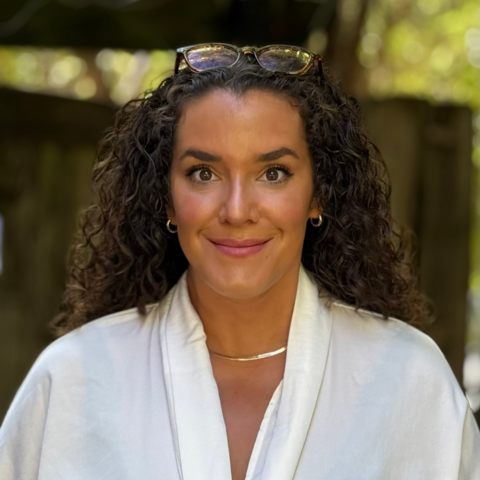
Originally from Michigan, Amelia Mueller-Williams carries a strong family legacy of social work. While her initial interest leaned towards anthropology and biology, her connection to the profession was shaped by her two paternal grandparents, both social workers and civil rights activists, and an uncle who is a social worker in Florida.
After earning an undergraduate degree in anthropology and biology from Macalester College, she merged her interests to pursue a career in social work and public health, later earning master’s degrees in social work and public health from the University of Michigan.
It was one job in particular that launched her career in social work. “I got a job using my qualitative interviewing skills learned as an anthropology major working on a social work research project,” she described her path to a career in social work. “This experience was life-changing for me, connecting with wonderful mentors who taught me about research and guided me to an academic research career.”
She worked for many years with both research teams and community organizations, where she “focused on optimizing and culturally tailoring treatment and prevention services for mental health and substance use among American Indian/Alaska Native communities, especially urban centers.” Dr. Mueller-Williams’ passion for this area continued throughout her scholarly journey, as she pursued her doctoral program in social welfare at the University of California, Los Angeles.
Her doctoral dissertation used data from the National Violent Death Reporting System to look at the association between socioeconomic context and mortality rates from suicide, alcohol, drug-related deaths, and deaths of undetermined intent among American Indian/Alaska Native, Black and White Americans. “The findings indicated that socioeconomic environment has a significant influence on these types of deaths, particularly among American Indian/Alaska Native and Black populations,” explained Dr. Mueller-Williams.
Her research utilizes community-based and culturally responsive approaches that advance our understanding of how social determinants and community conditions can shape mental health and inform suicide and firearm violence prevention and intervention strategies. She is interested in improving our understanding of the relationship between mental health and substance use in real-world settings using large datasets and recent projects focus on the role of social media in prevention and intervention efforts for young people at risk of substance use and adverse mental health outcomes.
Mueller-Williams’ teaching experience also primarily focuses on research methods, statistics and data-related subjects. “I enjoy teaching these subjects because they are incredibly important to well-rounded social work education and help empower individuals to better navigate their everyday lives,” she explained. “However, they often present a lot of challenges to students and inspire a lot of anxiety. I, too, was one of those students in the past, so I enjoy using different strategies to make the content accessible and relatable to students.” She also enjoys demonstrating how social work research and practice align and looks forward to being a part of the FSU College of Social Work and teaching Statistics for Social Workers this fall.