
Social Work Student Receives Award in FSU Graduate Op-Ed Competition
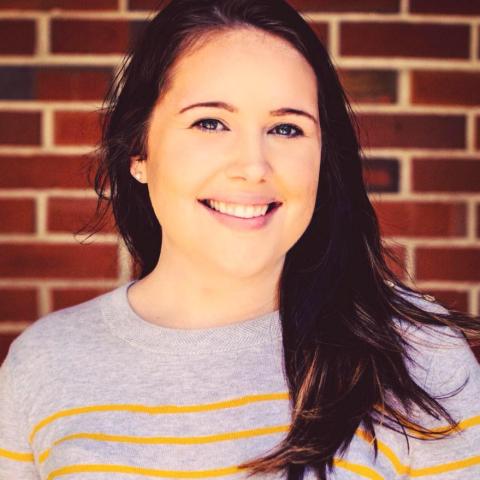
MSW student Sarah Lovins Bacani is both an FSU student and an FSU employee working within FSU Advising First, a part of the Division of Undergraduate Studies. "I currently work in the Center for Academic Guidance, where we specialize in early response interventions for students who are beginning to show signs of academic disengagement or risk of dropping out," she shared. "My primary interest has been student development, particularly helping students gain clarity and direction as they shape their academic and personal goals."
After almost a decade at FSU, first as an academic advisor and now as an academic guide, she found her passion for working with emerging adults in higher education.
It was this work and some encouragement from a fellow student that motivated her to participate in the FSU Graduate Op-Ed Competition, an event run by the Office of Graduate Fellowships and Awards that encourages graduate students to hone their communication skills when sharing academic and professional topics with non-expert or mass audiences. Each participant chosen receives a $500 research grant to support their research, education, or professional development. Sarah highly encourages other social work students to participate in the future to hone their writing skills. Sarah received the "Best Call to Action" award for her op-ed.
"I've always been drawn to writing, and I believe that strong writing is most powerful when it serves a meaningful purpose," explained Sarah. "The op-ed format became a natural avenue for me to grow these skills while engaging with issues I really care about."
And that's exactly what she wrote about in her op-ed, "The Hidden Curriculum of Care" (the full op-ed is below): the student experience that can often be lonely or isolating, and how faculty, curriculum, and other campus resources can create meaningful connections and purpose for students.
Sarah earned her undergraduate degree in 2015 from FSU in political science and geology, noting that her advisors' support was important to her success. Her degrees also gave her a strong foundation in systems thinking, scientific analysis, and the importance of data. After six years working in environmental science, she began her career at FSU, working with students. "Each step along the way helped shape the perspective I bring to my work today, combining analytical skills with a deep commitment to student development."
Her interest in the student experience led her to pursue her Master of Social Work degree. Through her work at FSU, she noticed clear trends in how students talk about success and achievement, supported by data that she wanted to share with others. “I love writing about issues that truly matter, and the op-ed format allowed me to combine meaningful insight with my natural sense of humor in a way that feels both engaging and accessible," she expressed.
Sarah also believes that writing is essential for social workers because of the professional’s central importance of lifting and supporting others. "Strong writing allows social workers to translate lived experience and research into language that moves people to care, reflect and act," Sarah stressed. "When we communicate clearly and compassionately, we amplify the voices of the communities we serve and help shape the conversations beyond the walls of our agencies."
She is honored that something she cares deeply about is being recognized and hopes to write more to share her knowledge and perspective with larger audiences.
The Hidden Curriculum of Care
by Sarah Lovins Baccani
On any given night, thousands of undergraduates sit in dorm rooms surrounded by people yet feel profoundly alone. Research shows that loneliness among emerging adults is at an all-time high, and universities are not immune.
Jeffrey Arnett first described the emerging adult population in the May 2000 edition of The American Psychologist. He originally outlined the age range as 10-25; it has since been revised to 18-29. The proposal of this life phase was in response to the evolving nature of identity exploration and the broad expansion of higher education as a cultural norm. Today, emerging adults comprise a significant portion of the population on college campuses.
But why are they lonely in dorm rooms?
The answer is not simple; in fact, we could make lists about their social media use, unwillingness to make phone calls, or some sort of intergenerational dig. Indeed, the data is consistent; as our college campuses grow larger, it becomes increasingly difficult for our students to develop a sense of belonging.
Presently, large universities are working diligently to develop student engagement and support programs focused on concepts such as retention, engagement, and proactive/reactive intervention; however, something is still missing. The student population has been vocal in their need: better relationships with faculty.
Students often say a professor’s perceived care or connection helps them feel they matter. This perception of faculty support fosters a sense of belonging, motivation, and academic commitment.
The collective groan is palpable. Don’t faculty have enough to do? Yes, absolutely, they do. The good news is that the ask is not a big one. Relational conversations and holistic student development can occur in both the classroom and through macro communication.
Faculty can provide personal narratives as part of their lecture material. When faculty share parts of their own stories or identities (within professional bounds), it can humanize them and give students relational footholds. Some work in STEM and physics contexts explore this. Faculty who share their own reasons for being ardent about their subject often inspire students to locate personal meaning as well.
Meaning also fosters motivation and persistence. When students see a clear link between course material and their life goals, values, or future roles, they engage more deeply and perform better. This is often described as purpose-driven learning or meaning-making pedagogy. Take the humble discussion board, for example.
When students share their thoughts online, they’re not just checking a box for participation points; they’re learning to translate ideas into written communication, to clarify complex thoughts, and to respond thoughtfully to others. It takes less than a minute to describe the meaning of that assignment, and it serves as a reminder of the skills our students are building.
Circling back to Jeffrey Jensen Arnette’s emerging adults, while he describes them as experiencing their existence as “in-between" he also consistently describes them as the age group of possibilities and optimism. Two traits that a person of value in their life can help foster to carry over to their next life phase.
At a time when undergraduates are still shaping their identities and testing their values, the most valuable presence we can offer is not certainty, but relationship, the steady reminder that who they are becoming is seen and supported.
We become people of high regard to emerging adults not by defining their values for them, but by walking with them as they discover their own.