
Art, Healing and Resilience: How Creative Expression Promotes Health and Growth
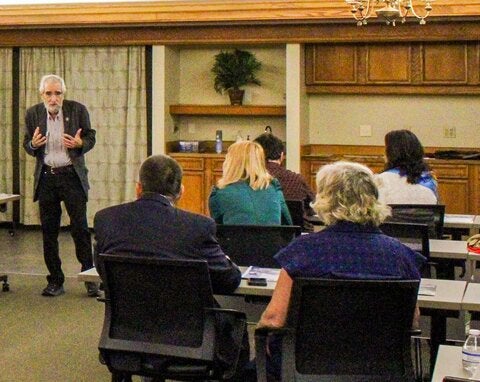
Florida State University’s Ukraine Task Force at the Learning Systems Institute, College of Social Work, Resilience Institute for Strength and Empowerment and Open Nights hosted a special event on February 20, 2026, focused on “Art, Healing and Resilience.”
The free event explored how different forms of art have helped people around the world heal and become more resilient. Speakers and presentations highlighted FSU’s ongoing work to advance research, promote student learning, support the creative arts and support our community near and far, close to home and across the globe.
The event featured a special art exhibit of East African and Ukrainian art along with a workshop on “The Place of Poetry in Advancing Personal Resilience and Growth Across the World” with Dr. Nicholas Mazza, poet-in-residence and emeritus dean and professor at the College of Social Work.
Keynote speakers also included FSU leadership such as:
- Kevin Maynard, director of FSU Opening Nights
- Dr. Stephen McDowell, associate provost of International Initiatives and interim dean of the Graduate School
- Dr. Anna Romanova and Dr. Vilma Fuentes, FSU Ukraine Task Force, Learning Systems Institute
“It was wonderful to see people coming together with the common purpose of utilizing creativity and art to promote healing in times of conflict and stress,” said Dr. Mazza. “The evening explored how different forms of art have helped people around the world heal and cultivate resilience in challenging times.”
Finding Healing with Words
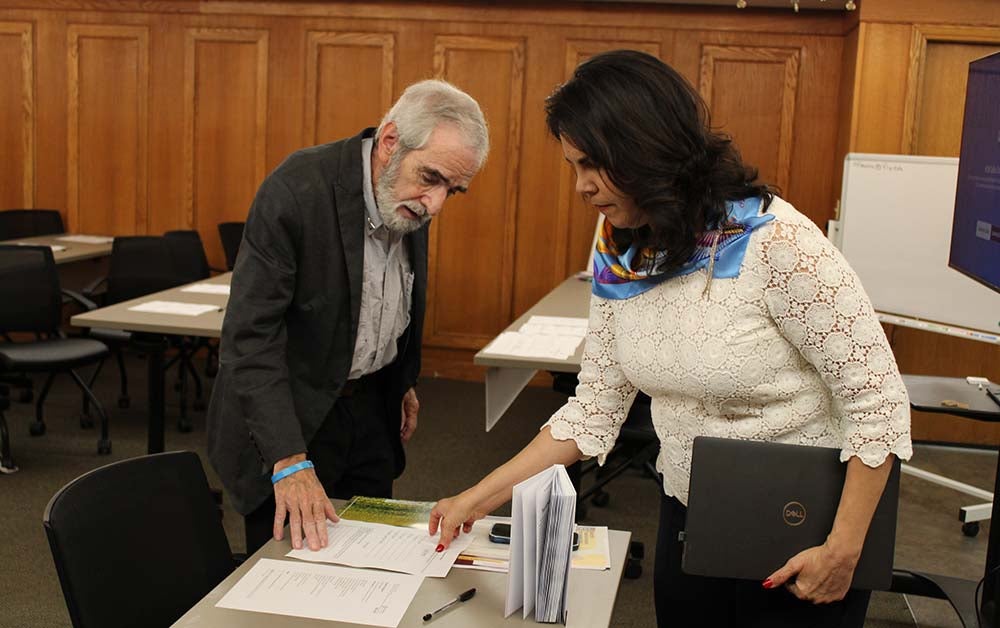
Dr. Mazza has utilized the arts, most notably poetry therapy, with a variety of participants for more than 50 years. By his definition, poetry therapy is the use of language, symbol, and story in therapeutic, educational, and community-building capacities.
One of his most recent projects has been to support the people of Ukraine. He was first approached by Ukrainian writer, performer, and folklorist Anna Shevchuk Liudnova, who read the latest edition of his book Poetry Therapy: Theory and Practice and knew of his work as the editor of the Journal of Poetry Therapy.
Liudnova, an expert at the Ukrainian Bok Institute and Ukrainian Cultural Foundation, had been organizing volunteer activities in Ukraine, primarily in hospitals, including poetry therapy workshops for military personnel, veterans, and their families who were impacted by war.
Dr. Mazza began offering poetry therapy workshops virtually with artists, crisis therapists and psychologists in Ukraine so they could use the techniques with other Ukrainian audiences to promote resilience-building and healing.
Among the many techniques he has used, Dr. Mazza has used the sensory poem approach with Ukrainian psychologists treating front-line military personnel. A sensory poem is a descriptive poem that uses vivid language appealing to the senses, including sight, sound, smell, taste, and touch, to bring a topic or subject to life. He shared the poem created collaboratively by one group of participants, which read:
Hope
Hope is the color green.
It sounds like bells.
It feels like fresh air.
It tastes like cocoa.
It smells like wildflowers.
It makes you feel like morning coolness,
inspiration, belonging, to something bigger,
and flying.
Just in the past 12 months, Dr. Mazza has conducted 6 workshops with Ukrainian professionals working directly with 100 participants. But the participants are not the only ones who have learned from these experiences. Since collaborating with Liudnova, Mazza has expressed learning a great deal about the rich cultural strengths and history of the people of Ukraine.
“I have never worked with such a compassionate, skilled, and thankful group of people,” he shared. “Anna and her colleagues are one of the most responsive and appreciated participants that I’ve ever known.”
Liudnova and Dr. Mazza’s partnership has expanded beyond workshops. Her recent bilingual book, in Ukrainian and English, titled Dialogue with Yourself: Recovery through Writing, on the techniques she has shared through her activities, includes a foreword, an introductory essay by Mazza, along with some of his poetry.
Promoting Healing Through Education
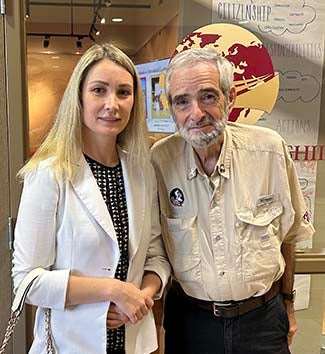
Through an invitation from Dr. Anna Romanova and Dr. Vilma Fuentes, Dr. Mazza also became involved with the FSU Ukraine Task Force, a partnership between FSU and Urkrainian researchers and scientists that allows them a variety of unique opportunities to collaborate.
Through the task force, Dr. Mazza has connected with artists, educators, and other professionals providing training and workshops, sharing poetry therapy as a therapeutic and educational tool used for healing and personal growth.
“Poetry and other expressive writing techniques play a critical role in recovery from trauma for a number of reasons,” Dr. Mazza emphasized. He shared that the benefits of poetry therapy include that it:
- Poetry therapy, like all therapies, restores and instills choice.
- Serves as a springboard to express thoughts and feelings, acting as a vehicle or voice to express trauma and other experiences.
- Begins a process for people to express feelings, such as pain or anguish, helping them to develop a measure of control and engagement in the healing process.
- Validates people's feelings through universalization, helping them feel less alone or isolated.
- On a group basis, poetry therapy is an opportunity to connect with others.
A closing point of a recent piece he wrote for the Italian Journal of Poetry Therapy concludes that: “Poetry therapy speaks to our humanity, strengths, and commitment. This is a poetic call to action for peace and justice. Poetry therapy has the potential to help individuals during troubled times to cope, provide support to others and speak out. Poetry affirms the human spirit and helps to ensure that those oppressed will not be forgotten. Poetry therapy can capture home, heritage, and hope, recognizing each country’s history and heroes.”
His poem captures this sentiment, titled “Prayer for Ukraine" (Journal of Family Social Work, 28:5, 195).
Amidst the sirens,
Shattered glass,
And ashes of what was once a home.
Anna is holding a sunflower.
More than a symbol of resilience and resistance,
It brings hope for healing in the hands and eyes
Of artists supporting healers
Who are aiding soldiers
Trying to protect their families
And all that is precious.
In their country,
Bringing the therapy of poetry from my side of Zoom
To Anna and her family
Knowing there is no safety from bullets and bombs,
But some comfort.
Some support.
Some hope.
Poetry is a small contribution.
Still, we know that we are not alone.
Still, we try.
Still, we keep fighting.
Still, we pray.
Still, we go on with one hand reaching to another.