
Two Social Work Doctoral Students Receive 2026 SSWR Travel Awards
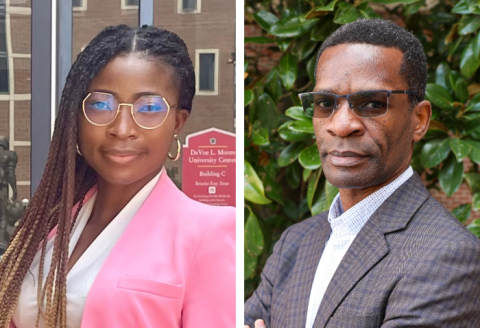
Two doctoral students from the Florida State University College of Social Work, Oluwaseun "Jay" Jegede and Ngondwe "Pons" Ponsiano, received highly competitive 2026 Society for Social Work and Research (SSWR) Travel Awards to support their participation in the annual conference held in January 2026. Each year, SSWR awards a limited number of travel stipends to doctoral students nationwide selected as presenting authors at the conference.
The SSWR Doctoral Travel Awards recognize both scholarly merit and the importance of engaging emerging researchers in national conversations shaping social work research, policy, and practice.
Pons, who also received a SSWR Travel Award in 2025, reflected on the role of conferences in doctoral development: "Conference experiences like this are an important part of the growth process for doctoral students like me."
Adding: "Presenting at academic conferences such as SSWR offers opportunities to broaden our perspective. There is a motivation to do the 'magis,' a Latin word for 'going beyond what is expected.' I learnt more than I shared, I received more than I gave, but most importantly, I was challenged not to settle for the minimum – to do more. Crucially, there is a sense of encouragement to go an extra step when you see the room is full on a Friday evening, when people are 'supposed' to be socializing."
Pons also said that this award leaves him with enough balance from the College to support him at the upcoming Joint Conference on Social Work, Education, and Social Development in June, in Nairobi, Kenya.
For Jay, this marked her first SSWR Travel Award. "Beyond the financial support, the award carries scholarly prestige," she said. "This year, SSWR designated only about 30 travel stipends to doctoral students serving as presenting authors. Being selected among hundreds of student attendees represented meaningful recognition of my work and affirmed its relevance within the field."
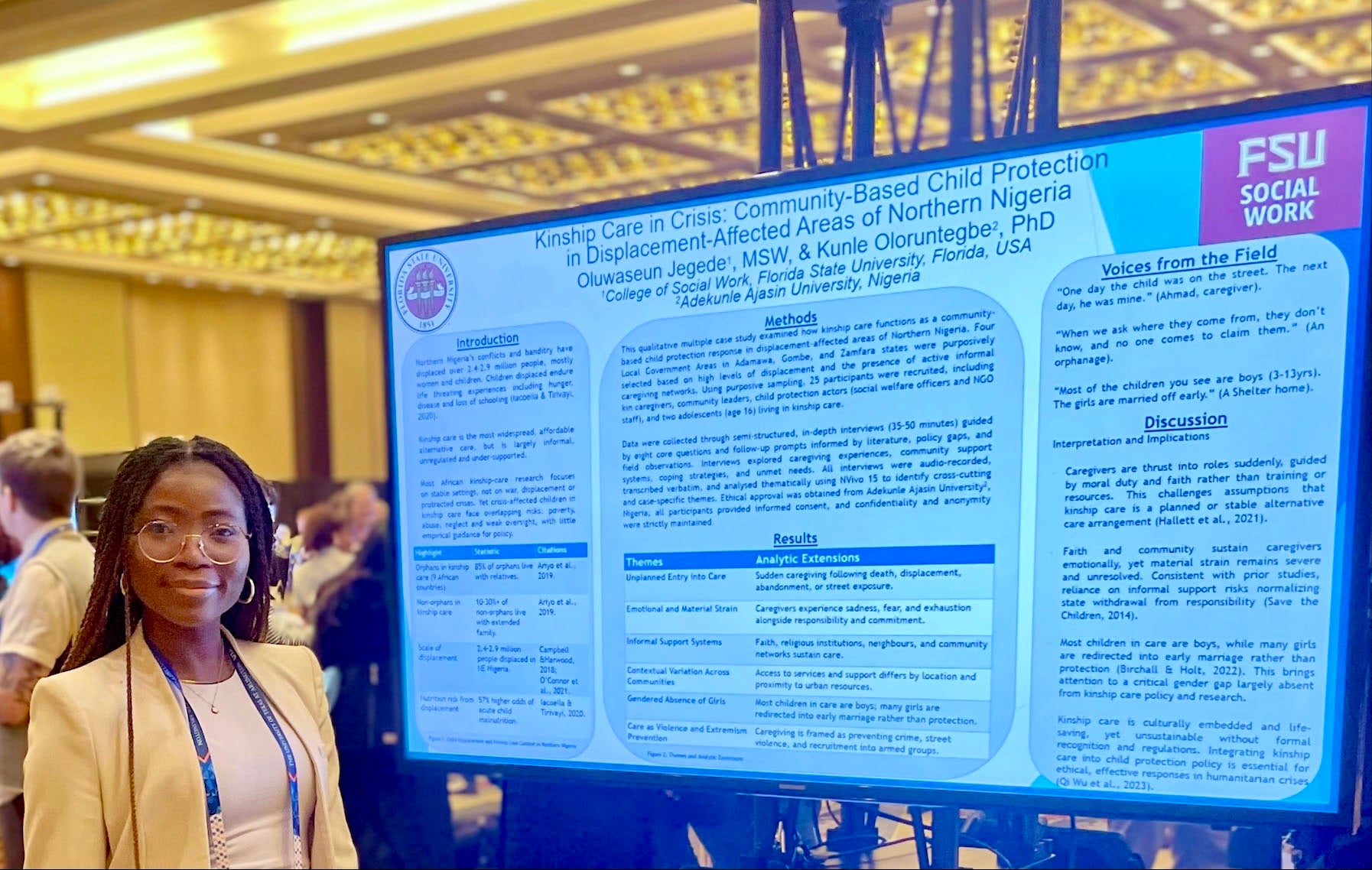
At the 2026 SSWR Conference, Jay presented a poster titled "Kinship Care in Crisis: Community Based Child Protection in Displacement-Affected Areas of Northern Nigeria." Her research examines kinship care as a critical child welfare strategy, focusing on how relatives and extended family networks provide care when parents are unable to do so, particularly in contexts shaped by displacement and structural instability.
Reflecting on her poster session, Jay emphasized the scholarly exchange that followed. "I was proud to share this work and to see how it resonated with other researchers," she said. "During and after my presentation, colleagues engaged with genuine curiosity, asked thoughtful questions, and expressed interest in accessing the manuscript, which further motivated me to prioritize moving the study toward public dissemination. These interactions helped me better understand the relevance and timelines of my work." In addition to her poster presentation, Jay participated in multiple conference sessions and connected with researchers and institutions through formal and informal networking events.
Pons also made substantial scholarly contributions at the conference, participating in 7 sessions and serving as lead presenter on two presentations, including an oral presentation on a scoping review about the mental health experiences of African refugees in the United States. Pons' presentations focus on the challenges refugees face after resettlement in the United States. During both presentations, Pons noted that he was "humbled by the many people who attended the two talks."
"There were many people, and all of them wanted to know more," he expounded. "One even asked for our presentation so that she could present it to her class. I feel encouraged when an already established person asks for my work to share it with others."
Pons' and Jay's work, along with those of other FSU College of Social Work faculty, students, and collaborators contributed to more than 35 sessions at the 2026 SSWR conference.
Although both Pons and Jay have presented before at international conferences, Jay described how the SSWR conference became a "dynamic space where research becomes dialogical rather than one-directional."
She added that the conference setting created opportunities for doctoral students to grow in several ways, noting that:
- The conference provides a space for students to engage with researchers whose work they may have encountered only in print, enabling them to ask deeper questions about methodology, data sources, and analytical decisions.
- Presenting research within a conference environment allows students to situate their work within broader scholarly conversations and to refine their thinking through constructive feedback.
Observing how SSWR and institutions supported scholars preparing for the academic job market offered essential insights into the broader landscape of social work academia. "Ultimately, I will say attending a research conference is a transformative experience that deepens intellectual confidence, expands perspective, and affirms one's place within an academic community," affirmed Jay